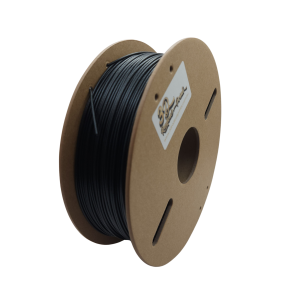
PETG-GF is standard PETG reinforced with short glass fibre strands, significantly boosting rigidity, dimensional stability, and heat resistance while keeping most of PETG’s easy printability. It also gives a distinctive frosted, matte finish with fewer visible layer lines than regular PETG.
PETG-GF is considerably stiffer and more dimensionally stable than standard PETG, resisting warping and shrinkage far better. It also offers improved heat resistance and electrical insulation, making it a step up for rigid, load-bearing, or technical parts rather than general-purpose printing.
Most PETG-GF prints between 240–270°C on the nozzle, with a bed temperature of 65–80°C. Exact settings vary by brand, so always check the specific product listing for the manufacturer’s recommended profile.
Yes, a hardened or wear-resistant steel nozzle is strongly recommended. Glass fibre is abrasive and will wear through a standard brass nozzle over time, widening the orifice and affecting print accuracy.
They excel in different areas. PETG-CF generally offers a higher stiffness-to-weight ratio and a matte black finish, while PETG-GF is non-conductive, available in a much wider range of colours, and puts less wear on hotend components like heatbreaks and PTFE tubing than carbon fibre.
No. Unlike carbon-fibre filaments, PETG-GF is electrically insulating, making it a safer choice for electronics housings, insulators, and components where conductivity would be a problem.
PETG-GF suits rigid, load-bearing parts such as gears, bearings, jigs, fixtures, drone frames, and outdoor or damp-environment components, thanks to its combination of stiffness, water resistance, and dimensional accuracy.
Like standard PETG, it’s hygroscopic and absorbs moisture from the air, which can affect layer adhesion and surface finish. Store opened spools in a dry environment and use a filament dryer if print quality drops after extended exposure to humid air.