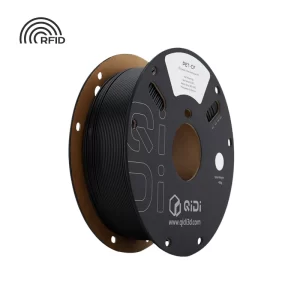
PET (polyethylene terephthalate) is the true, unmodified polyester behind materials like water bottles, refined into a 3D printing filament. It’s semicrystalline, rigid, and heat resistant, distinct from PETG, which has glycol added to make it easier to print.

PETG has glycol added to the base PET polymer, which breaks up its crystal structure and makes it amorphous, easier to print, and more impact resistant. True PET keeps its semicrystalline structure, giving it higher stiffness and better heat resistance, but it’s harder to print and more brittle than PETG.
Yes. PET generally needs a higher nozzle temperature and a heated bed to print well, and it’s more prone to warping and brittleness than PETG. It rewards a well-tuned setup and typically benefits from an enclosure, making it better suited to printers already dialled in rather than a first material.
PET typically prints hotter than PETG, often in the 250–270°C range on the nozzle with a bed around 80–90°C, though exact settings vary by brand and any added reinforcement like carbon fibre. Always check the specific product listing for the manufacturer’s recommended settings.
PET offers greater stiffness, better dimensional stability, and higher heat resistance than PETG, making it a good option for parts that need rigidity rather than flexibility. Carbon-fibre-reinforced PET (PET-CF) takes this further, adding significant strength and stiffness for demanding functional and engineering parts.
Yes. PET is hygroscopic and readily absorbs moisture from the air, which can cause hydrolysis (the material breaking down when heated while wet) as well as stringing and poor layer adhesion. Store opened spools in a dry environment and dry before printing if the filament has been exposed to humid air.
Yes. PET is one of the most widely recycled plastics, and recycled PET (rPET) filament is a common, more sustainable option for 3D printing, offering similar properties to virgin PET at a lower environmental footprint.