
Description
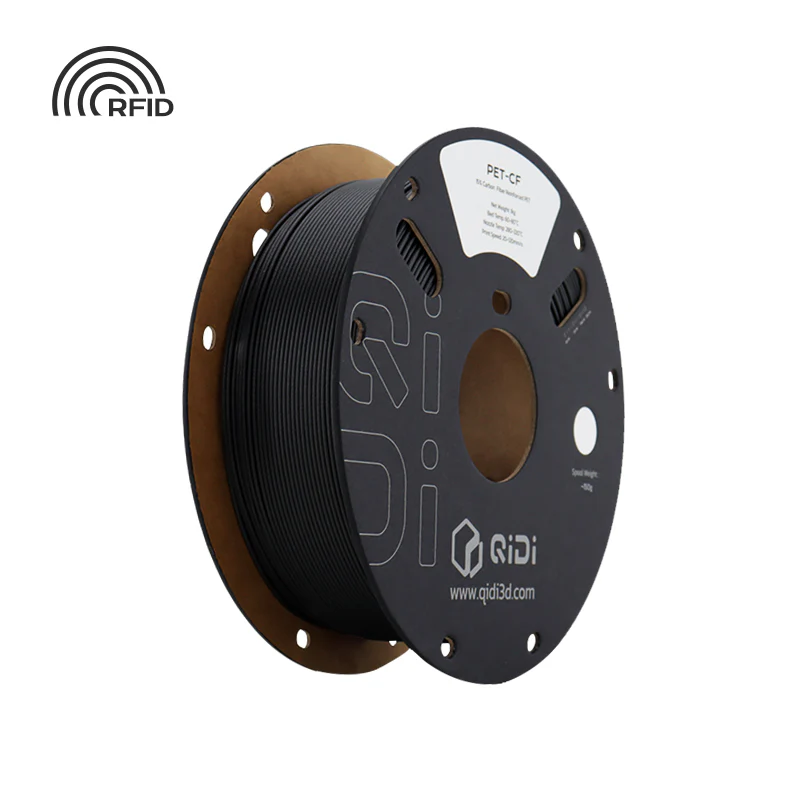
Qidi Tech PET-CF — 15% Carbon Fibre Reinforced Engineering Filament
Qidi PET-CF is a 15% chopped carbon fibre reinforced PET filament engineered for high-strength, dimensionally stable parts that don’t warp, don’t shrink, and don’t absorb moisture the way nylon-based composites do. With a moisture absorption rate of just 0.5%, PET-CF maintains its mechanical properties and dimensional accuracy even in humid Australian conditions — no constant drying, no degradation during storage, no surprise print failures from moisture.
It prints with good dimensional stability and no heated chamber requirement, producing parts with a glossy finish and beautiful surface texture. For applications that demand strength, heat resistance, and chemical resistance without the moisture headaches of PA-CF, PET-CF is the answer.
Why PET-CF Over Other Engineering Filaments?
PET-CF vs PA-CF (Nylon Carbon Fibre)
PA-CF absorbs moisture aggressively — even a few hours of open-air exposure can degrade print quality. PET-CF’s 0.5% moisture absorption means it stays stable for far longer, with minimal drying required. PET also has better creep resistance than nylon, meaning parts hold their shape under sustained load over time.
PET-CF vs PETG-CF
PET and PETG are related but not identical. PET-CF offers higher strength, higher rigidity, better heat resistance, and superior creep resistance compared to PETG-CF. PET’s molecular structure has a rigid benzene ring that gives it mechanical properties closer to engineering-grade nylon than to standard PETG. The trade-off is higher print temperatures (280–320°C vs 220–250°C for PETG-CF).
PET-CF vs PC-CF (Polycarbonate Carbon Fibre)
Both are high-performance materials. PC-CF offers higher impact resistance, while PET-CF offers better chemical resistance, lower moisture absorption, and easier printability with no heated chamber required.
Key Properties
Dimensional Stability
Qidi’s Smart Fiber Reinforcement Technology releases internal stresses through the carbon fibre mesh structure during printing, resulting in parts that don’t warp or shrink — even without an enclosed chamber. This is a significant advantage for large parts and tight-tolerance assemblies.
Low Moisture Absorption
At just 0.5% moisture absorption, PET-CF is one of the least hygroscopic engineering filaments available. Moisture has virtually no effect on its mechanical properties or dimensional stability. While drying before first use is still recommended, PET-CF is far more forgiving than PA-CF in storage and handling.
Creep Resistance
PET’s rigid molecular chain structure gives it superior resistance to creep — gradual deformation under sustained load. Parts printed in PET-CF hold their shape and dimensions under long-term mechanical stress better than PA or PC equivalents.
Chemical Resistance
PET-CF inherits PET’s excellent resistance to oils, greases, fuels, and most common solvents and chemicals.
Applications
Functional prototypes requiring strength and dimensional accuracy, automotive brackets, ducting, and under-bonnet components, jigs, fixtures, and tooling for manufacturing, chemical-resistant enclosures and housings, drone frames and structural components, any load-bearing part where creep resistance and low moisture sensitivity are critical
Print Settings
Nozzle temperature: 280–320°C — requires an all-metal hotend rated for these temperatures
Bed temperature: 80°C (with glue stick)
Print speed: 40–200 mm/s
Diameter: 1.75 mm ±0.02 mm
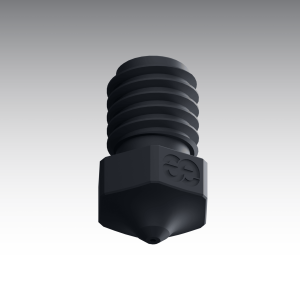
Nozzle: hardened steel required — brass and copper-plated nozzles are not recommended
Minimum nozzle size: 0.4 mm — 0.2 mm nozzle is not compatible
Heated chamber: not required but enclosed printer recommended
Drying: 100°C for 4–8 hours before first use
Storage: humidity below 15% RH in sealed bag with desiccant
Support Material
PET-CF can be paired with Qidi S-White soluble support material to solve complex support structures on models with overhangs and internal geometry that would be difficult to remove with breakaway supports.
Post-Print Annealing
For maximum mechanical performance, parts can be annealed at 80–100°C for 4–8 hours and cooled to room temperature naturally. Annealing increases crystallinity, improving strength and heat resistance beyond the as-printed values.

Reviews
There are no reviews yet