
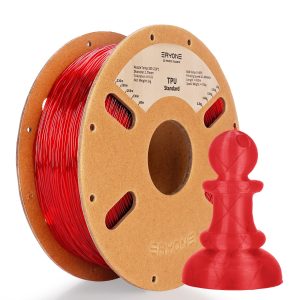
TPU 90A is a flexible thermoplastic polyurethane filament rated at 90A on the Shore hardness scale, sitting between the firmer, easier-to-print 95A TPU and the softer, more rubber-like 85A grade. It offers a noticeably softer, more elastic feel than 95A while remaining more manageable to print than lower Shore ratings.
The lower the Shore A number, the softer and stretchier the material. 90A flexes and compresses more than 95A, giving a squishier feel that suits grips, cushioning, and wearable parts, but it requires slower print speeds and more careful tuning since softer filament is more prone to buckling in the extruder.
Most TPU 90A prints between 210–230°C on the nozzle, with a bed temperature of 30–60°C. Keep print speed low, generally 15–25mm/s, since the softer material needs a slower, steadier feed than firmer 95A TPU to avoid jamming or inconsistent extrusion.
A direct drive extruder is strongly recommended for 90A. The shorter filament path gives much better control over feeding softer filament, and Bowden setups often struggle with buckling and inconsistent extrusion at this hardness, even with reduced speed and retraction.
Jamming with softer TPU is almost always caused by printing too fast, excessive retraction distance, or a filament path with too much clearance around the drive gear. Slowing down, minimising retraction, and ensuring the extruder gear is tensioned firmly against the filament are the first fixes to try.
Yes. Like other TPU grades, 90A is highly hygroscopic and absorbs moisture quickly, causing stringing, surface bubbling, and weak layer adhesion. Dry before printing if the spool has been open for more than a few days, and store it sealed with desiccant between sessions.
The softer feel of 90A suits grips, cushioning pads, wearable props, phone cases with more give, and parts that need extra flex or shock absorption beyond what 95A can offer, while still being firm enough to hold detail and shape.