
Description
IckySticky Thick Foam Safe CA — Gap-Filling Gel That Won’t Destroy Your Foam
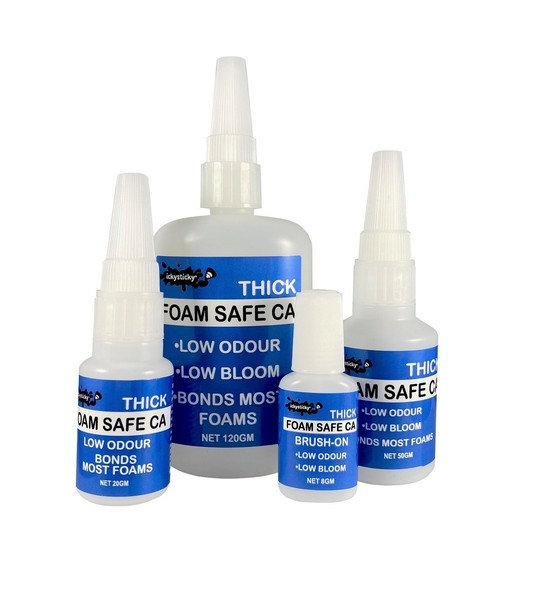
IckySticky Thick Foam Safe CA combines the gap-filling gel viscosity of Thick CA with foam-safe, low-bloom chemistry. It stays exactly where you apply it, fills gaps between ill-fitting foam parts, bonds on vertical surfaces without dripping, and gives you the longest working time to position parts — all without melting, distorting, or discolouring foam materials.
If you’re building foam terrain, assembling RC foam aircraft with imperfect joints, or bonding heavy parts to foam structures, this is the adhesive that does the job without destroying what you’re building.
Available in three sizes — 20g, 50g, and 120g.
Three Sizes Available
20g
Compact size for hobby desks and RC field kits.
50g
Mid-range option for regular terrain builders, RC hobbyists, and cosplay makers.
120g
Workshop bottle for heavy foam work and large terrain projects. Best per-gram value.
All sizes include a pin cap to prevent nozzle clogging between uses.
Why Thick + Foam Safe?
Thin Foam Safe CA is great for wicking into tight joints, but it flows away from gaps and can’t bridge uneven surfaces. Thick Foam Safe CA solves this — the gel consistency stays where you apply it, fills gaps between parts that don’t mate perfectly, and holds heavier components in place on foam structures while the bond sets.
Use Thick Foam Safe CA When
Foam parts have gaps or uneven surfaces that thin CA would flow past
Bonding heavy parts (motors, servos, landing gear) to foam structures
Working on vertical or overhead foam surfaces where thin CA would drip
Building up material on foam edges and corners for reinforcement
Bonding rough or porous foam surfaces that need filling and bonding in one step
Foam Safe Chemistry
Standard thick CA generates heat and fumes during curing that melt EPS, dissolve XPS, and distort foam board. Thick Foam Safe CA uses a modified formula that cures with significantly less heat and without the aggressive vapours — keeping foam intact while still producing a strong, lasting bond.
The low-blooming chemistry also means no white frosted residue around the bond area, making it suitable for cosmetic bonds, clear parts, and visible joints.
What It Bonds
Foam Materials
Foam board (Depron, dollar tree foam board)
XPS foam (extruded polystyrene — blue/pink insulation board)
EPS foam (expanded polystyrene — white bead foam)
Cell foam, EVA foam, and craft foam
Other Compatible Materials
Balsa wood, plywood, carbon fibre, fibreglass, aluminium, metal, resin, ceramic, acrylic, PVC, polystyrene, polycarbonate, PETG, PEEK, latex, and wood
Thin vs Thick Foam Safe — Which to Choose
Thin Foam Safe CA
Water-like viscosity. Wicks into tight joints by capillary action. Bonds in 1–5 seconds. Best for well-fitting foam joints, wicking along seams, and penetrating porous foam surfaces.
Thick Foam Safe CA
Gel viscosity. Stays exactly where applied. Longest working time. Best for gap-filling on ill-fitting foam parts, vertical surfaces, bonding heavy components to foam, and any foam joint where control matters more than speed.
For the most versatile foam building kit, stock both.
Pro Tip — Pair with Foam Safe Activator
Use Thick Foam Safe CA as a gap filler, then spray with IckySticky Foam Safe Activator for an instant cure. This technique is widely used in RC foam aircraft building for rapid structural repairs and in terrain building for bonding and filling in one step. Always use the Foam Safe Activator — standard CA activators can damage foam.
Specifications
Type: Cyanoacrylate (CA) adhesive — thick gel viscosity, foam safe
Viscosity: High (gel, non-drip)
Blooming: Very low
Odour: Low
Available sizes: 20g, 50g, 120g
Cap: Pin cap to prevent nozzle clogging
Made in Australia

Reviews
There are no reviews yet