
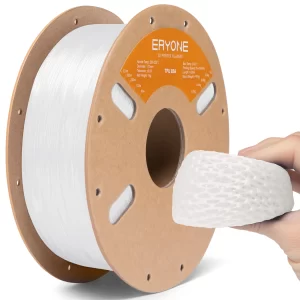
TPU 85A is a soft, highly flexible thermoplastic polyurethane filament rated at 85A on the Shore hardness scale, making it one of the more rubber-like grades of TPU available. It stretches and compresses significantly more than firmer grades, closer to the feel of a rubber band than a stiff plastic part.
The lower the Shore A number, the softer and stretchier the material. 85A is noticeably softer and more elastic than 90A or 95A, which makes it better suited to parts that need real cushioning or squish, but it’s also the hardest of the three to print reliably due to how easily it buckles under pressure.
Most TPU 85A prints between 205–225°C on the nozzle, with a bed temperature of 30–60°C. Print speed needs to be kept very low, generally 10–20mm/s, since this soft a filament buckles easily in the extruder if pushed too fast.
Yes, a direct drive extruder is essential for reliable results with 85A. The short filament path gives the control needed to feed such a soft material consistently, and Bowden setups will almost always struggle with buckling and inconsistent extrusion at this hardness.
Jamming with 85A is almost always caused by printing too fast, using retraction that’s too aggressive, or a filament path with too much clearance around the drive gear. Slowing down significantly, minimising retraction, and ensuring firm gear tension against the filament are the first fixes to try.
Yes. Like other TPU grades, 85A is highly hygroscopic and absorbs moisture quickly, causing stringing, surface bubbling, and weak layer adhesion. Dry before printing if the spool has been open for more than a few days, and store it sealed with desiccant between sessions.
The soft, rubbery feel of 85A suits cushioning pads, soft grips, wearable props, seals, and parts that need significant squish or shock absorption, where firmer TPU grades like 95A would feel too rigid.